
The 10x Rep
Can an individual software salesperson reliably carry a $10 million annual quota, hit it, and actually enjoy the job?

For the past three years, one question has occupied my mind: Can an individual software salesperson reliably carry a $10 million annual quota, hit it, and actually enjoy the job? And what technology is missing to make that possible?
I began thinking about this equation while managing the initial AI rollout for the GTM teams at Asana three years ago. As I watched execution-focused AI tools improve, the question grew harder to ignore. Selling is still one of the hardest jobs in business, and technology will not change that. However, the most time-consuming parts of the work have suddenly become incredibly fast. Company research, call prep (& follow-up), and personalized emails can now happen in a few minutes.
Yet, sales performance has not experienced a matching leap. For a decade, the discipline stayed largely flat, and recently it has entered a sharp decline.
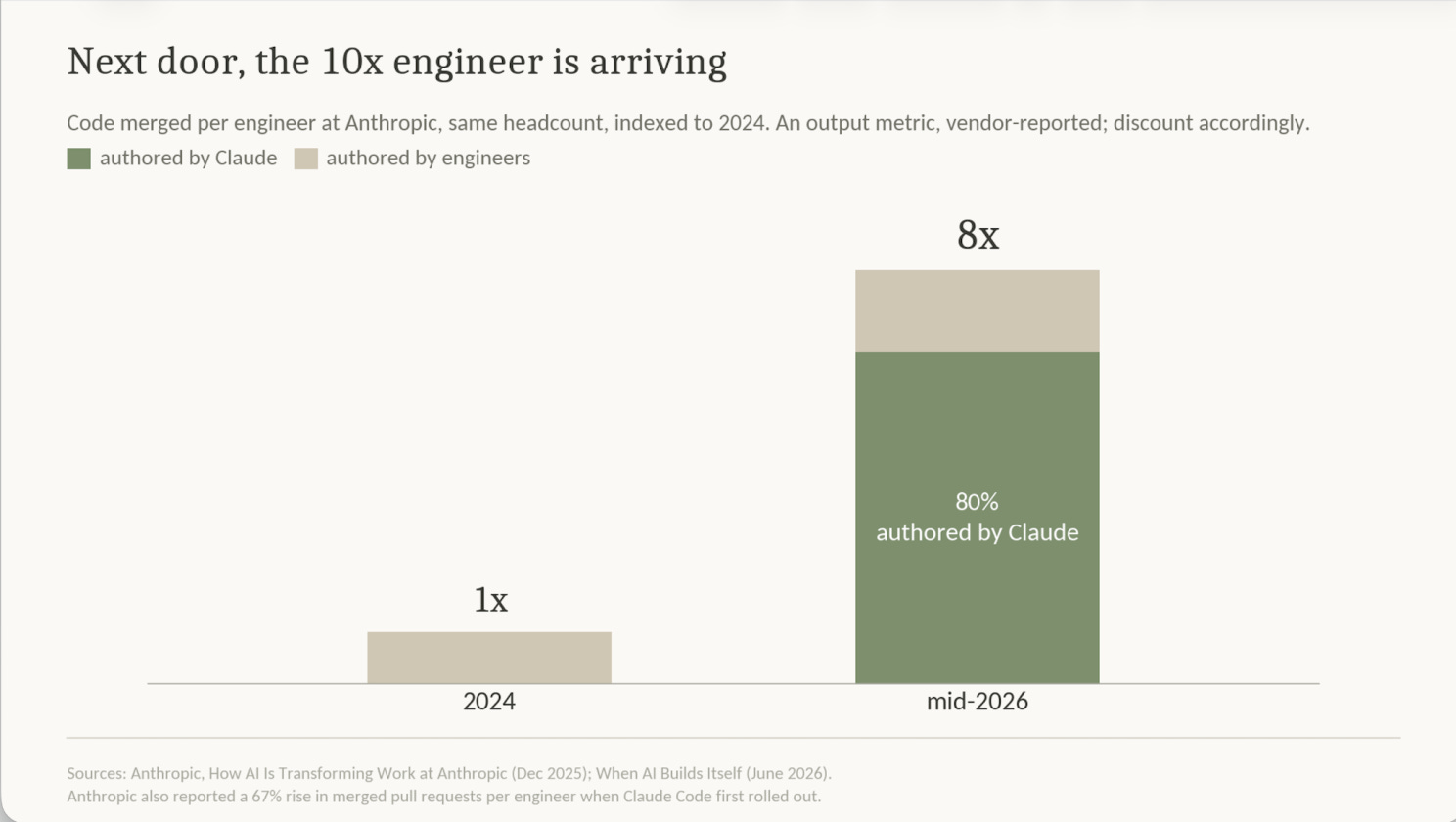
Directly across the hallway, engineering teams are putting up numbers that look made up. Anthropic Engineers are shipping eight times more code per person than they did two years ago. While it is true that this compares two entirely different metrics - engineering is measured by absolute output, while sales is measured by a managed quota ratio - the underlying puzzle remains real.
Why is one side of the building multiplying its raw output while the coordination of the other side struggles under the weight of more powerful tools?
Answering that question requires looking past individual tools to examine how teams are organized. This essay is the first of a four-part series examining what it would take for a salesperson to carry ten times today’s quota:
Part One (Today): The 10x Rep.
Part Two: What Happens When Execution Gets Cheap.
Part Three: The Two Jobs Left.
Part Four: The 10x Go-To-Market Organization.
The Slack Barrage
The problem with the common approach to GTM innovation crystalized during a recent conversation with a sales leader I respect. He lead GTM at a company that helped build the automation industry, and his team was engineering new sales processes years before the title GTM Engineer was a thing. If any team should be living in the high-tech future, it is his.
Instead, he described a state of daily confusion, his representatives open Slack every morning to a wall of automated alerts. Chatbots issuing a constant stream of commands: contact this executive because of a corporate event, this account just increased its product usage, this buyer changed jobs.
Separately, each of these alerts is intelligent and useful. Taken together, they are overwhelming. Because none of these automated systems know what the others are doing, or what the human team is planning, coordination across the GTM team was breaking down. Here was one of the most automated cultures in software, and its leader wanted to discuss how uncoordinated his team had become.
This conversation stayed with me because it highlights exactly where AI has succeeded and where it has failed. We have transformed how individuals complete tasks, but we have not touched how teams work together.
The Breakdown of the Loop
If you strip sales down to its basic mechanics, it has always operated as a loop. First, you plan an account by identifying who matters, what they need, and what to do next. Second, you execute that plan through research, outreach, and meetings. Finally, you learn what worked so you can run the loop again on the next account, a little smarter each time.
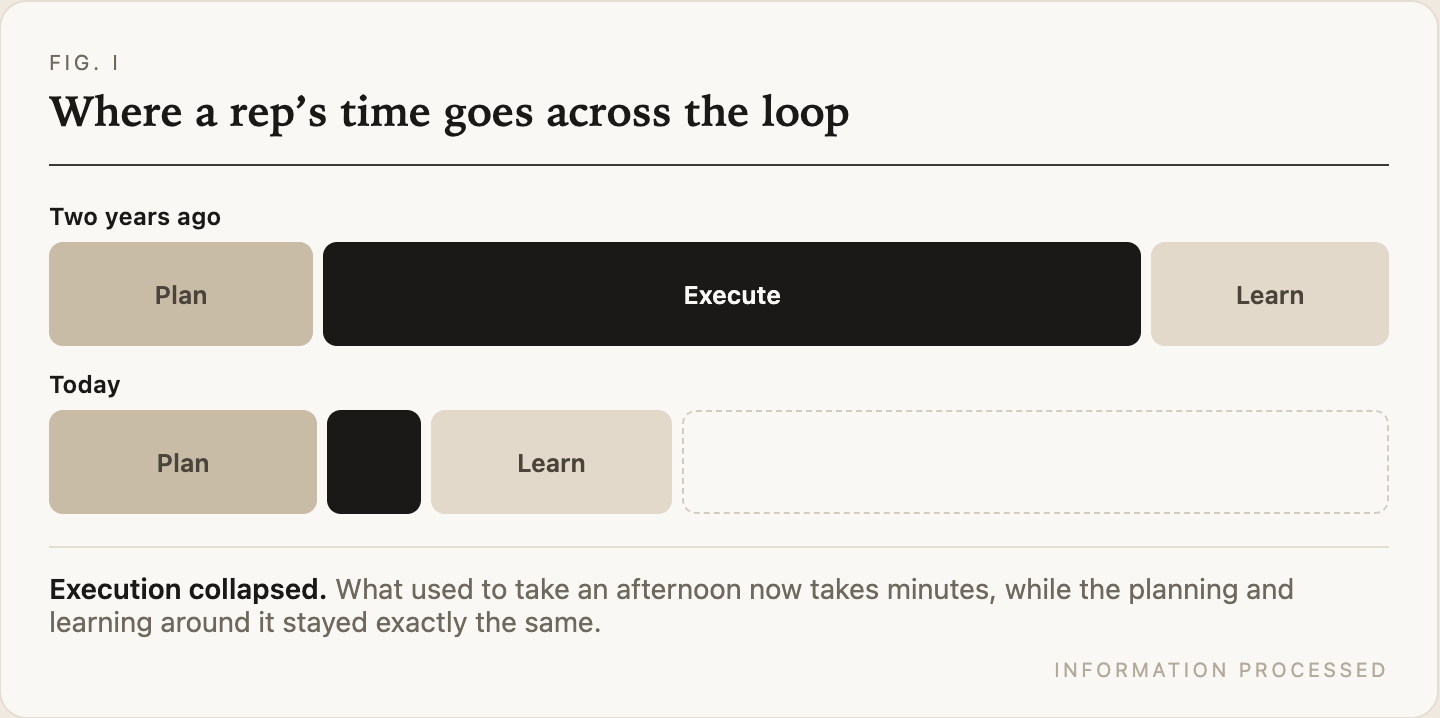
What changed over the last two years is that execution became incredibly fast. Modern AI tools can handle call preparation, deep company research, and custom briefs, returning a strong first draft in a few minutes. This does not replace human judgment, but the time required to complete these individual tasks has disappeared.
However, this speed introduces a major problem. If you can suddenly complete ten times more tasks in a day, the critical question changes from “Can I do this?” to “Which of these things is actually worth doing?”
Our brains are not equipped to plan at this scale. It is incredibly difficult for a person to manage a full book of accounts, coordinate moves with teammates, and track tenfold more open conversations all at once. Furthermore, no company I chatted with keeps score of which actions actually help a relationship or close a deal. The lessons from successful accounts remain trapped in personal anecdotes. Without a central system to guide them, teams point this massive new AI capacity at whatever digital alert happens to be the loudest.
That morning Slack barrage is exactly what this structural failure looks like in practice.
The Denominator
Most claims about multiplying productivity hide their baseline numbers, so I want to lay out the data clearly. According to the benchmark survey from The Bridge Group, the median software account executive carries an $800,000 new-business quota, up from $740,000 in 2022. Roughly half of those representatives actually hit that number: 51% according to sales leaders, and just 43% when you ask the representatives anonymously on platforms like RepVue.
Therefore, a $10 million new-business quota is exactly 12.5 times today’s median quota. I round down to “10x” because it is a cleaner title, but the actual target is even higher.
Two details are important regarding this scope. First, this thesis applies strictly to net-new business acquisition. Many strategic account managers already oversee portfolios worth $5 million to $10 million, but that revenue comes mostly from renewals and account expansion (NRR, instead of ARR). Second, extreme performers do exist. Data from Ebsta shows that just 17% of salespeople generate 81% of total revenue across millions of analyzed opportunities.
The closest documentation of an individual hitting a $10 million net-new year is buried in an older commission lawsuit against IBM. A representative was owed roughly $1 million in commissions on two massive deals in 2016. Assuming a standard standard enterprise commission rate of roughly ten percent, that meant he brought in approximately $10 million in bookings. It was an incredible year, and the public only learned about it because the company tried to cap his paycheck.
The real question is not whether these exceptional outliers exist, but whether a company can build a repeatable system that produces them on purpose without burning the human out.
As a mechanism proof-of-concept, we can look at founder-led sales. Early-stage founders routinely grow their startups to $1 million or $2 million in net-new annual revenue largely by themselves. While this level of leverage is still far below our $10 million target, it proves an important point: it works because the entire sales loop lives inside a single human head. Every customer conversation, every change to the pitch, and every account plan exists in the same place.
However, the limit of this approach appears the moment the sales loop requires more than one person.
The Illusion of Stability
This conversation is unfolding against an alarming trend in quota attainment, though the numbers must be interpreted carefully.
When The Bridge Group surveyed sales leaders from 2012 through 2022 about the percentage of their teams hitting full quota, the data showed a remarkably stable plateau. In 2012, it was 74%. For the next decade, it stayed near two-thirds: 67% in 2015, 65% in 2020, and 66% in 2022. The metric was so predictable that analysts began treating it as a natural market equilibrium.
Then, in just two years, that stability collapsed, dropping to 51%, the lowest result in the history of the survey.
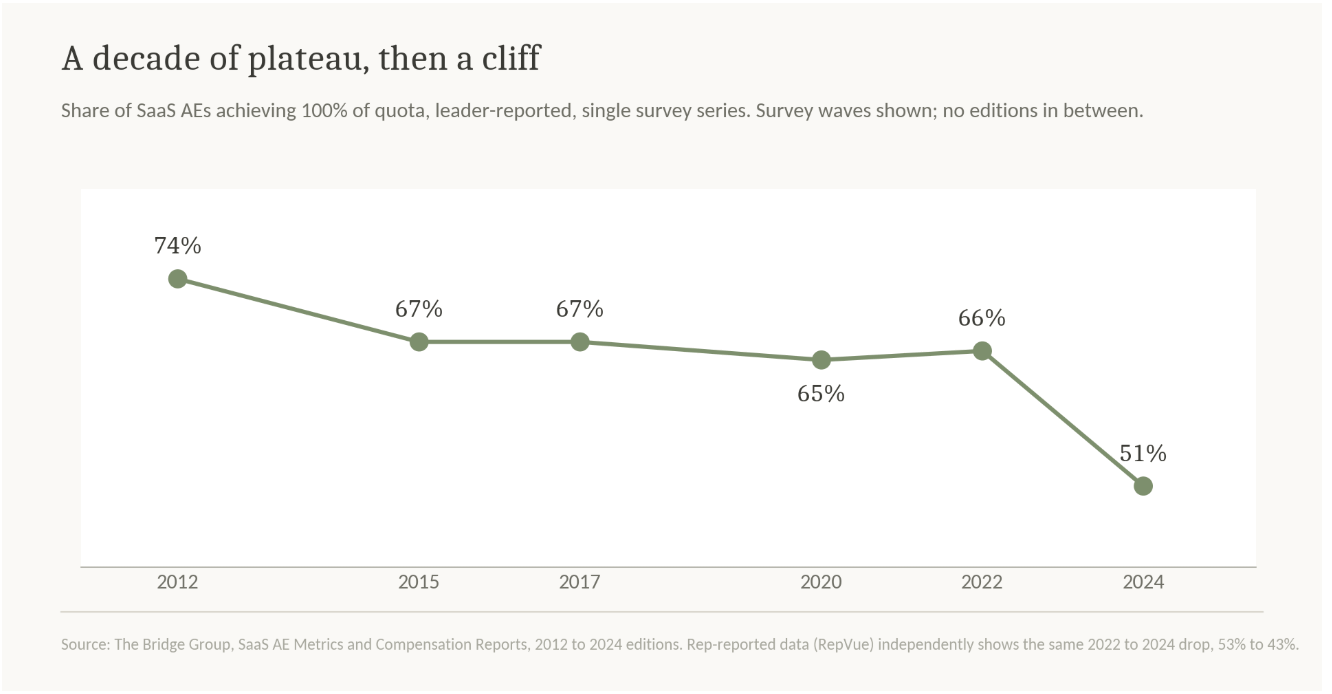
RepVue’s data from the representatives themselves confirms the same sudden drop, falling to roughly 43% through 2024. Early 2025 data from RepVue show’s similar numbers.
We must acknowledge a clear alternative hypothesis for this cliff: macroeconomic demand. This drop arrived at the exact same time corporate procurement budgets tightened after the 2021 tech boom. A pure demand-side contraction, paired with rising quotas, is entirely sufficient to depress attainment numbers without any reference to sales productivity or coordination.
However, our hypothesis is that the macroeconomic crunch was severely aggravated by a supply-side failure: the sudden wave of automated AI outbound messages that hit the market at the exact same moment, causing buyers to completely tune out. We are currently asking whether an individual representative can carry ten times the revenue weight at the exact historic moment the average team stopped reliably delivering a normal quota.
Why Engineering Advanced and Sales Fractured
To understand why sales has fallen behind engineering, look at how the two disciplines coordinate their work. Anthropic recently published its internal engineering metrics, which showed a flat headcount alongside a roughly eightfold increase in code merged per engineer over a two-year period. While code volume is an output rather than an outcome, the trend is real.
The system was able to scale this far only because software engineering spent the last thirty years building the infrastructure required to absorb speed. Version control systems give engineering teams a single, universally trusted record of the project. The “pull request” is a strict protocol designed to merge one person’s isolated work into the whole group’s project.
Sales has none of this infrastructure. It has no universally trusted record of an account, and no protocol for folding an individual representative’s breakthrough into the company’s memory. Because there is no structured system to capture the sudden explosion of automated outbound activity, sales teams try to coordinate knowledge using the only tool they have left: sending constant, frantic messages in Slack.
There is an important objection to consider here. Code is a controllable, internally verifiable artifact. Revenue depends entirely on an external counterparty and slow, noisy feedback from the market.
I believe that this revenue feedback loop is closable, and this is what we are working on.
Two Approaches
When some imagine AI in sales, they usually think about replacement. They picture autonomous digital agents running outbound prospecting, backed by a much smaller human staff. That approach is currently facing a difficult trial in the market, and the early returns are poor. The initial wave of “AI SDR” companies spent the past year walking back their marketing claims because email servers began blocking the massive influx of automated spam.
The alternative approach is the one taken by Salesforce. On a recent earnings call, leadership announced a freeze on engineering hires, citing a 30% productivity lift from internal AI tools. At the same time, they announced plans to hire thousands of new human sales representatives.
This hiring pattern is consistent with a stark reality: engineering hiring could stop because output per engineer exploded, while sales hiring had to grow because output per sales representative has stalled. Of course, this decision could also simply mean that AI substitutes for engineering work more cleanly than for relationship-based sales, or that sales is currently their primary growth constraint.
Broadly, companies looking to scale revenue face a few distinct paths. They can transition to product-led, self-serve growth to reduce reliance on human teams entirely. They can replace human representatives with software agents, which is currently struggling. They can hire massive armies of traditional salespeople at the same historic output, which remains incredibly expensive. Or, they can fundamentally elevate the revenue capacity that a single human being can manage.
The Trap of the Plateau
Building the early versions of these automated systems at Asana taught me that technology does not always scale smoothly. We started with basic internal chatbots and simple workflows, eventually deploying custom agents alongside our GTM teams.
The initial efficiency gains were real and immediate. Salespeople shifted from manual typing and data entry to acting as editors and reviewers. Then, our productivity curve hit an invisible ceiling.
We had succeeded in making every individual salesperson faster at completing isolated tasks. Yet, the collective sales team was not more focused or strategic than it had been before the technology arrived. Every tool we deployed helped an individual execute a task, but none of them helped the team plan, and none of them systematically learned.
We discovered that optimizing for doing more tasks at a faster pace is entirely different from optimizing for doing the right things, repeatedly, in perfect coordination with the teammates who can help you close a deal.
To break through this plateau and reach a higher peak of productivity, companies cannot just keep buying faster execution tools. We have to tear down our fragmented processes and rebuild our coordination infrastructure from scratch. That gap between software that blindly completes a task and a system that strategically plans and learns is the defining challenge of the next era of business.
A Diagnostic
Before we move to the data in Part Two, consider a brief exercise that takes about fifteen minutes.
List every artificial intelligence tool currently used across your immediate team, including both the official software and the unofficial applications your employees use quietly. Then, ask one question about each item:
Does this tool merely help an isolated person complete a single task faster, or does it actively help the broader team plan and learn together?
Next in the series
In Part Two, What Happens When Execution Gets Cheap, I dig into what actually happened when everyone in go-to-market got the same superpower at the same time. If you want it the moment it lands, subscribe below.
And if any of this is playing out on your own team, I would love to hear where you think I am wrong.
What we are building at Enzo: getenzo.io
Written by Ethan DeWaal, Co-Founder & CEO of Enzo